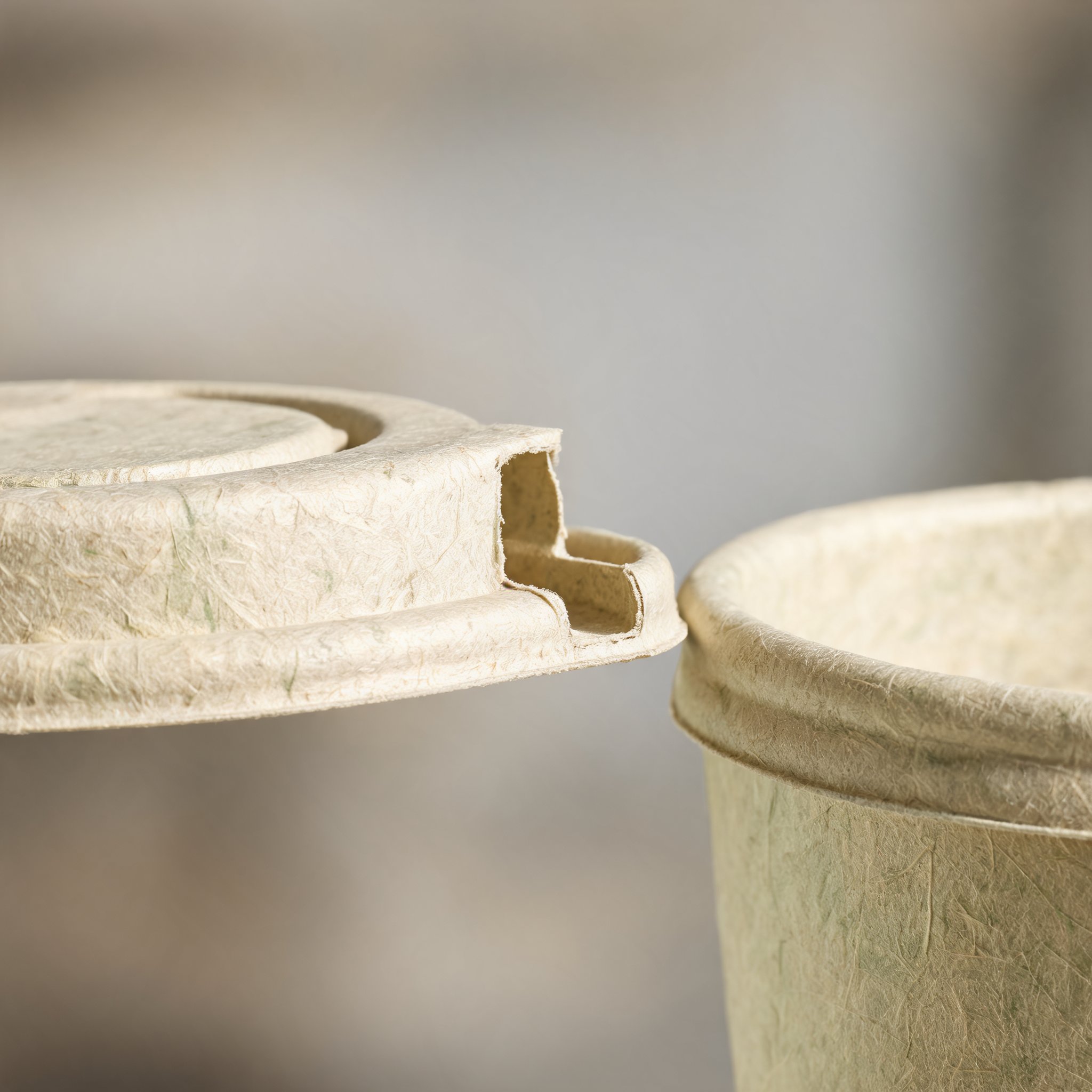
Yangi has added an undercut feature to its dry-forming platform for moulded fibre packaging, extending the technology to closure designs that depend on precise snap-fit geometry. The company is demonstrating the capability with a coffee lid, a component that has been technically difficult to produce in moulded fibre because secure fits often rely on accurate undercuts.
Undercuts are widely used in plastic packaging to create a mechanical connection between a lid and a container. Reproducing that geometry in moulded fibre is challenging. Yangi says its new feature delivers a secure, consistent fit, with the demonstration coffee lid showing a measured removal force of 6 N.
The lid was tested through 10 simulated coffee pours over 10 minutes. According to Yangi, it maintained a leak-tight seal and structural integrity when exposed to hot beverages at 93°C. The results relate to the demonstration lid and are reported by the company.
Applications beyond coffee lids
Yangi says the undercut technology is also suitable for fitted closures in snack containers, takeaway containers, dessert and ice-cream tubs, confectionery packaging, dry and ambient food containers, and packaging for personal care products, cosmetics and consumer goods.
Carlo Semeraro, head of Commercial Partnerships at Yangi, said that achieving this level of precision in dry-moulded fibre requires advanced tooling and forming expertise. He said the coffee lid demonstrates the performance available today, but the larger opportunity lies in applying the functionality to a wider range of packaging applications.
Cellera platform and production claims
The undercut capability builds on Cellera, Yangi’s dry-forming platform powered by its patented FiberIQ fibre formation system. Unlike conventional wet moulding, the process forms fibre without a water-based forming step. Yangi expects this to reduce water and energy requirements in the production of renewable, fibre-based packaging.
In the coffee lid application, Yangi estimates that Cellera’s four-second production cycle can reach an output of 300 lids per minute. The platform is designed for high-volume, cost-competitive manufacturing, combining precise fibre distribution with advanced forming technology to target consistent quality and functional performance.
Scale-up, emissions and industry context
The undercut announcement follows Yangi’s commissioning of its serial Cellera machine platform. Yangi has said that combining Cellera with the dry-forming process is expected to reduce resource consumption and CO2 emissions by 70% to 80% compared with conventional plastic alternatives.
Yangi will display the undercut feature and other developments in its dry-moulded fibre packaging range at the Sustainable Packaging Summit in Utrecht from 10 to 12 November 2026. Visitors to Stand 28 in the Networking Zone will be able to view Cellera dry-forming technology through an immersive virtual-reality experience.
Separately, PulPac licensee Hébert Group has partnered with Andritz to scale up production of Dry Molded Fiber trays and lids. The partners are targeting water- and energy-efficient manufacturing using renewable or recycled fibres.