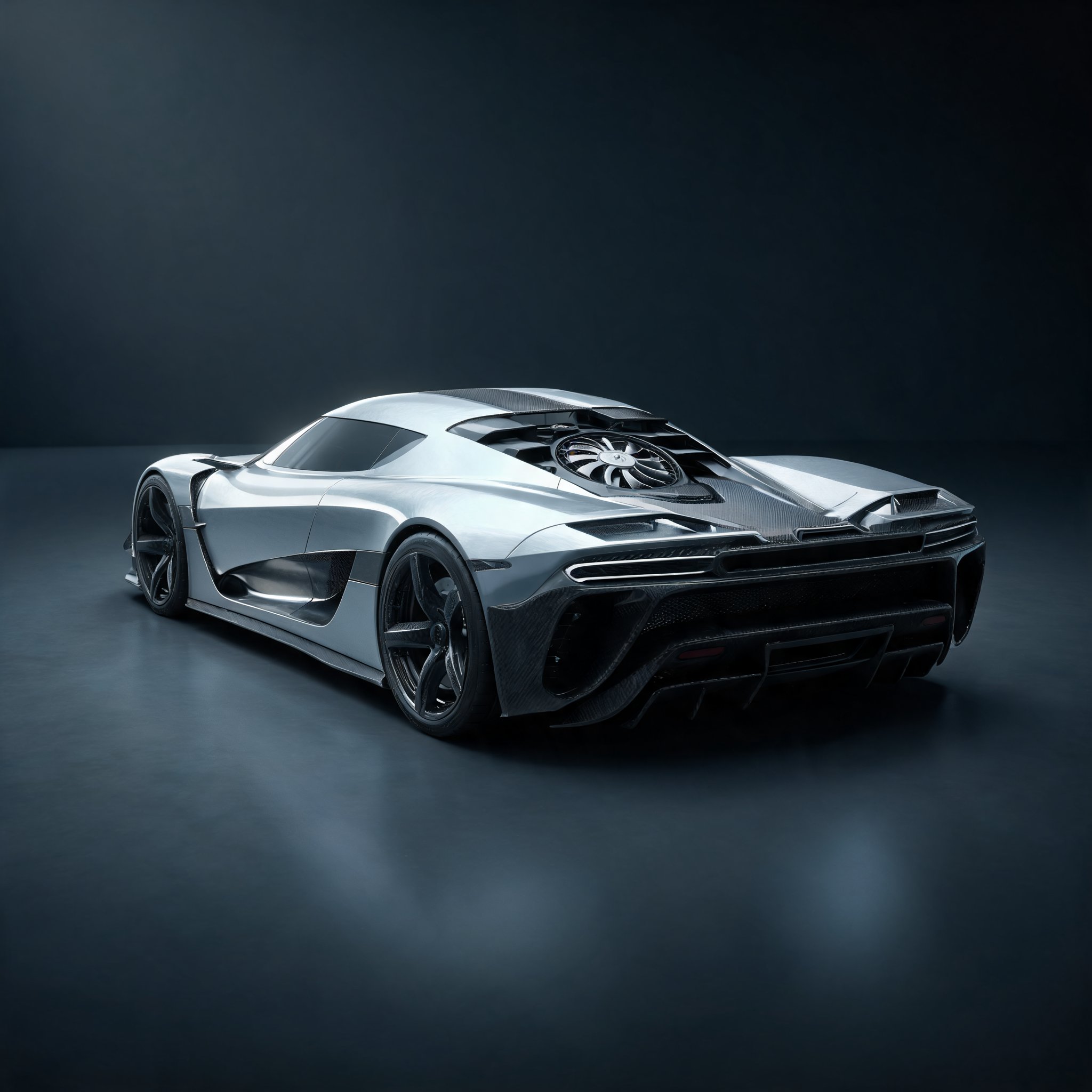
Porsche has unveiled the Mission S, a mid-engine supercar concept that places its engine behind the driver and ahead of the rear axle. The automaker says a production version will hold a permanent place in its lineup, rather than serving as a one-off show car or a limited-run hypercar, and will sit above the 911.
That is an unusual position for a brand whose road cars are more commonly rear- or front-engined. Mid-engine models have been relatively rare in Porsche's history, with the Boxster and Cayman twins the best-known examples. Porsche is presenting the Mission S as a performance flagship for the future rather than a styling exercise.
Design draws on Porsche's racing past
The concept's styling is deliberately aggressive, and several cues trace back to the company's competition cars:
- A flattened front end loosely derived from the GT1 Le Mans racer.
- A rear half with hints of the 959.
- A prominent radiator fan mounted atop the engine, in the style of the 917.
Powertrain still undisclosed
Porsche has not said which engine powers the Mission S, though the car will use internal combustion. The German outlet Handelsblatt reported in September that such a powerplant was under development at Porsche, and other elements of that report — the car's place at the top of the lineup and a possible price around half a million dollars — align with what is known about the Mission S. That figure is unconfirmed, though for context a 911 can be optioned past $300,000.
Speculation about the engine has centered on a newly developed flat-eight, which remains a guess rather than a confirmed detail.
An analog cabin without a large center screen
Porsche emphasized analog engagement at the debut. A knob that resembles a manual or sequential shifter has "PRND" markings beside it, and metal paddle shifters sit behind the steering wheel, pointing to an automatic transmission rather than a manual.
The interior is clearly driver-focused: controls are canted toward the driver's seat, and depending on the drive mode the tachometer extends closer to the driver for a clearer view. As is typical for Porsche, five circular gauges sit on the dash and the key is inserted on the left.
Notably, there is no large center display. Porsche said it deliberately avoided a permanently integrated center display or a fixed passenger display, choosing instead a retractable, MagSafe-compatible smartphone system. The owner's phone can serve as a navigation or information display, and the My Porsche App gives access to functions and lets users select digitally rendered, historically inspired designs for the circular instruments. Even the comfort and driving-control knobs located below the phone mount pull out and push back in.
What comes next
Porsche has confirmed that customers will eventually be able to buy some version of the car, describing it as a "permanently available super sports car offer." The company's previous concept of this kind, the Mission X, was presented in 2023 as a potential successor to the 918 Spyder.