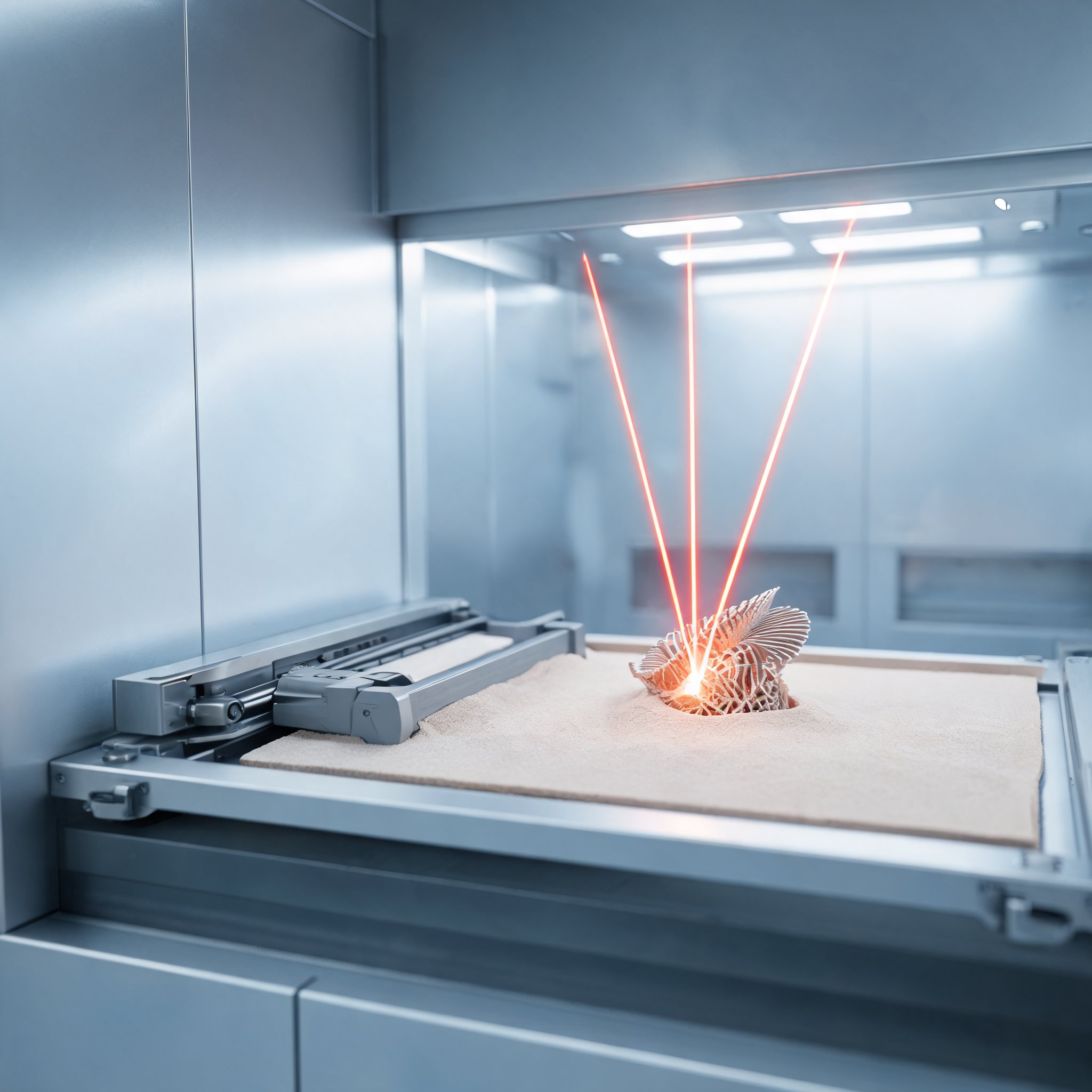
EOS's next polymer powder bed fusion platform is still under wraps, but one early evaluation partner is already reporting a sizeable productivity jump. Materialise, the additive manufacturing service provider, tested the soon-to-launch system under real production conditions and recorded 44% higher productivity than on the previous EOS platform, together with a build-time reduction of more than six minutes per part.
The machine is set to be fully detailed on November 17 at Formnext 2026, where EOS will present it at its booth (hall 12, booth D71). Until then, the company has confirmed only a handful of architectural features of the new system.
Aerospace part put through its paces
As part of the evaluation, Materialise used the platform to produce a cable twist wheel for GKN Aerospace. Beyond confirming that the machine could print the component — which it did — the service provider set out to assess reliability, the impact of the new features, productivity and efficiency, usability and control, and how straightforward the printed parts were to post-process.
Three lasers and dynamic load balancing
The new platform is built around a three-laser architecture with intelligent utilization and dynamic load balancing. According to the company, the load-balancing function "maximizes output per build by equally balancing the exposure workload", while the added laser capacity contributes to the higher productivity.
Giovanni Vleminckx, process engineering manager at Materialise, said the three lasers make a visible difference in performance, and that their intelligent utilization helps the company reach considerably higher throughput while maintaining the part quality its customers expect.
On the cable twist wheel build, Materialise measured productivity gains of 44% against the previous machine, with build time per part falling from 19:53 to 13:51 minutes.
Process control and downstream handling
The system also offers extended process controls, letting users work with validated parameter sets or open them up for finer control aligned to specific applications and KPIs. Vleminckx noted that it was not one isolated feature but the overall performance that stood out, combining the productivity needed with the process stability and control required to bring demanding applications into production.
Materialise also reported downstream benefits. An advanced roller recoater produces softer powder cakes, which makes it easier to unpack and depowder parts and reduces handling effort. Vleminckx described the softer powder cake as a very tangible improvement for operators, making the overall workflow noticeably more efficient.
Why it matters for a service provider
The combination of a three-laser architecture, the new roller recoater and open process controls is especially relevant for a manufacturing service such as Materialise, which has high-throughput requirements and must adapt to different production applications. EOS plans to reveal the full technical details of the platform on November 17 at Formnext 2026.