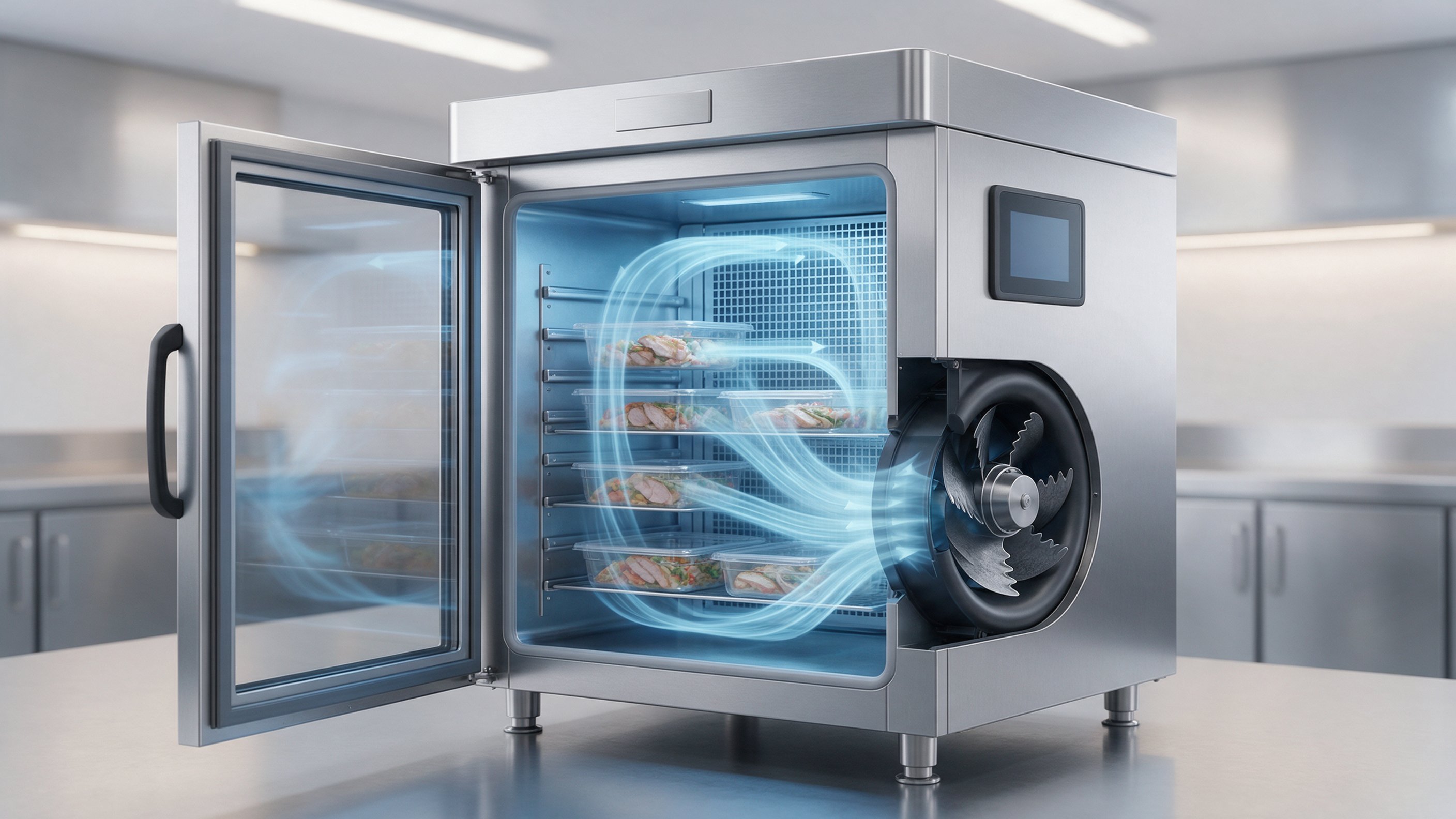
Professional refrigeration is being recast around food safety, energy use and regulatory compliance, and blast chillers sit at the centre of that shift. Rapid cooling has moved from a specialist kitchen function to a standard practice across catering, hospitals, hotels and food processing, according to the account. The equipment's core task is to reduce food temperatures from more than 70°C to below 3°C in as little as 90 minutes by circulating cold air intensively. That matters because it shortens the period in which food remains in the microbiological danger zone between roughly 63°C and 4°C, a principle associated with HACCP systems.
The claimed benefits go beyond compliance. Rapid cooling is said to limit bacterial growth, extend shelf life and better preserve texture, moisture, aroma and nutritional value. It is also linked to production planning, reduced food waste and improved organisation in high-volume kitchens. These are presented as operational advantages of faster cooling rather than as measured results from a specific installation.
Airflow becomes the decisive component
In conventional equipment assessments, attention tends to fall on the refrigeration circuit, compressor or evaporator. The argument here is that actual blast-chiller performance depends heavily on how uniformly cold air reaches the load. Heat transfer works only when airflow covers the entire product; areas of low velocity or turbulence can leave parts of the food cooling more slowly. Those temperature differences can affect safety, cooling time and final quality.
That makes the fan a strategic element rather than an accessory. EC, or electronically commutated, motors are described as an advance over traditional drive systems because they combine high electrical efficiency with continuous speed control. The airflow can then be adjusted to each stage of the cooling process. When EC motors are combined with biomimetic impeller designs and next-generation composite materials, the account says the result is more uniform cold-air distribution and lower energy consumption. It also states that the approach can shorten cooling time or avoid nominal-rate operation, and can replace large external controllers in some arrangements, freeing space for food in the chiller.
The account also attributes lower noise and heat generation to better turbulence control and EC motor operation. Lower heat generation is said to improve refrigeration-system performance, while lower mechanical stress and more precise control are linked to longer service life and reduced maintenance. These claims point to a design logic in which airflow, motor control and cabinet layout are treated as one system rather than separate parts.
Digital controls connect cooling to management
Digitalisation is the second pillar. Modern blast chillers can select programs according to food type, monitor temperature through probes and record the entire process for traceability, according to the account. That record is valuable during food-safety audits and helps with HACCP compliance. Open communication protocols such as Modbus allow units to be integrated into kitchen infrastructure and building management systems, supporting remote monitoring and predictive maintenance.
Continuous analysis of temperatures, fan speeds, operating hours and energy consumption can reveal deviations before they become failures, according to the account. This is presented as a way to reduce maintenance costs and improve equipment availability. The implication is that a blast chiller is no longer only a cooling box; it becomes a monitored process step whose data can be used by operators and service providers.
European rules widen the design brief
The regulatory background is changing as well. The European Union has set increasingly ambitious objectives for reducing energy consumption and carbon emissions, prompting a revision of rules for energy-related products. The Ecodesign framework is described as moving beyond energy performance alone to include durability, repairability, digitalisation and efficiency at both component and system level. The Ecodesign for Sustainable Products Regulation, or ESPR, is presented as a turning point for the next generation of equipment.
Although many measures will arrive progressively, the 2026 horizon is already influencing decisions by manufacturers and engineering firms. Performance improvements will not depend only on the refrigeration circuit; motors, fans, heat exchangers and electronic systems will be equally important in meeting market expectations. This shifts the design question from simply adding cooling capacity to optimising the performance of every component in the installation.
From components to system responsibility
ZIEHL-ABEGG is used as an example of the trend. Its EC axial fans for commercial refrigeration and food service are described as combining high-efficiency motors, optimised aerodynamics, low noise and communication through open protocols for integration into intelligent energy-management systems. The broader point is not a single product but a model of collaboration between equipment manufacturers and specialists in ventilation, electronic motors and controls.
That model changes roles across the chain. Manufacturers are expected to keep investing in equipment that can meet tighter rules. Installers, meanwhile, will need more expertise in electronics, connectivity and control systems because customers are asking for lower operating costs and high reliability, not only cooling capacity. The account suggests that installation professionals can become technology advisers across the equipment lifecycle through intelligent components, remote monitoring and predictive maintenance.
The boundary is important. The account does not provide measured energy savings, payback periods or comparative test data for a specific blast chiller. Its component-level claims depend on uniform airflow, correct installation, load configuration and control settings. It also presents EC motors and digital controls as enablers of efficiency, not as guarantees that every installation will achieve the same result. The overall message is that food safety remains the primary objective, but meeting it increasingly requires an integrated approach in which airflow, energy efficiency, digitalisation and sustainability are designed together.