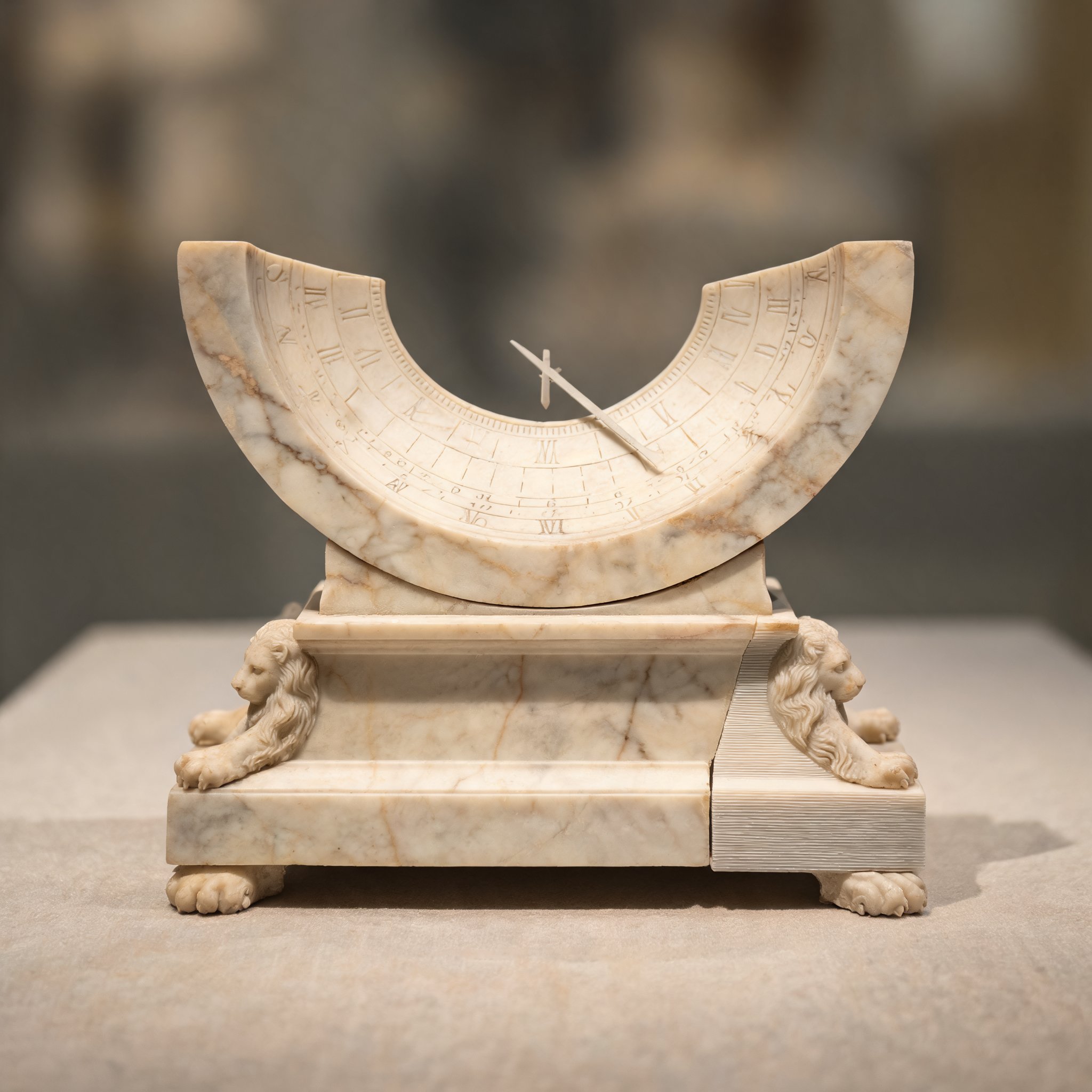
A Roman marble sundial has returned to public view at the Oreste Nardini Civic Archaeological Museum in Velletri, Italy, after a restoration that used 3D printing to recreate a missing lion’s paw.
The artifact is a hemicyclium, a concave sundial. Its treatment followed the principle of reversibility: the printed paw can be removed at any time without damaging the original marble. The work restored the sundial’s legibility and stability after a long period of neglect.
The project was funded by the LoveItaly association through money raised by its WeLoveItaly charity initiative, in collaboration with the Municipality of Velletri and the Museum Grand Tour network.
Raffaella Silvestri, director of the Oreste Nardini Civic Archaeological Museum, said the ancients built the sundial to measure time and that the restoration is intended to keep time from erasing their memory.
Conservators Rebecca Picca Orlandi and Cecilia Balsi reconstructed the sundial’s history from documents, historical accounts and archival photographs. That research informed the restoration plan.
The earliest known reference dates to 1790, when Carlo Antonini’s “Manual of Various Ornaments Drawn from Ancient Structures and Fragments” placed the sundial in Velletri’s Piazza di Corte, now Piazza Cesare Ottaviano Augusto. From at least 1829 it sat above the entrance of the Tempietto di Santa Maria del Sangue, until the building became a World War I memorial in the 1930s and the sundial moved to City Hall.
Later records traced changes to the object. American archaeologist Sharon Gibbs measured and sketched the sundial in 1971, and her drawings showed both lion’s paws intact. Photographs in a 1972 catalog record showed one paw missing, while images published in 2003 by Nicola Severino revealed further losses on the upper part of the dial.
The printed element replaces only the lost portion of the object. Because it can be separated from the marble, the restoration does not lock the museum into a permanent intervention and leaves the original material available for future examination.
The project also reflects the museum’s effort to make the object stable and readable for display while retaining its archaeological character. The restoration therefore combines a modern fabrication method with a documented, reversible conservation approach.
The hemicyclium was designed specifically for Velletri’s latitude. It tracked the passage of time through the year as well as the hours of the day. Its return to display follows research and conservation work that combined historical evidence with a removable printed component.