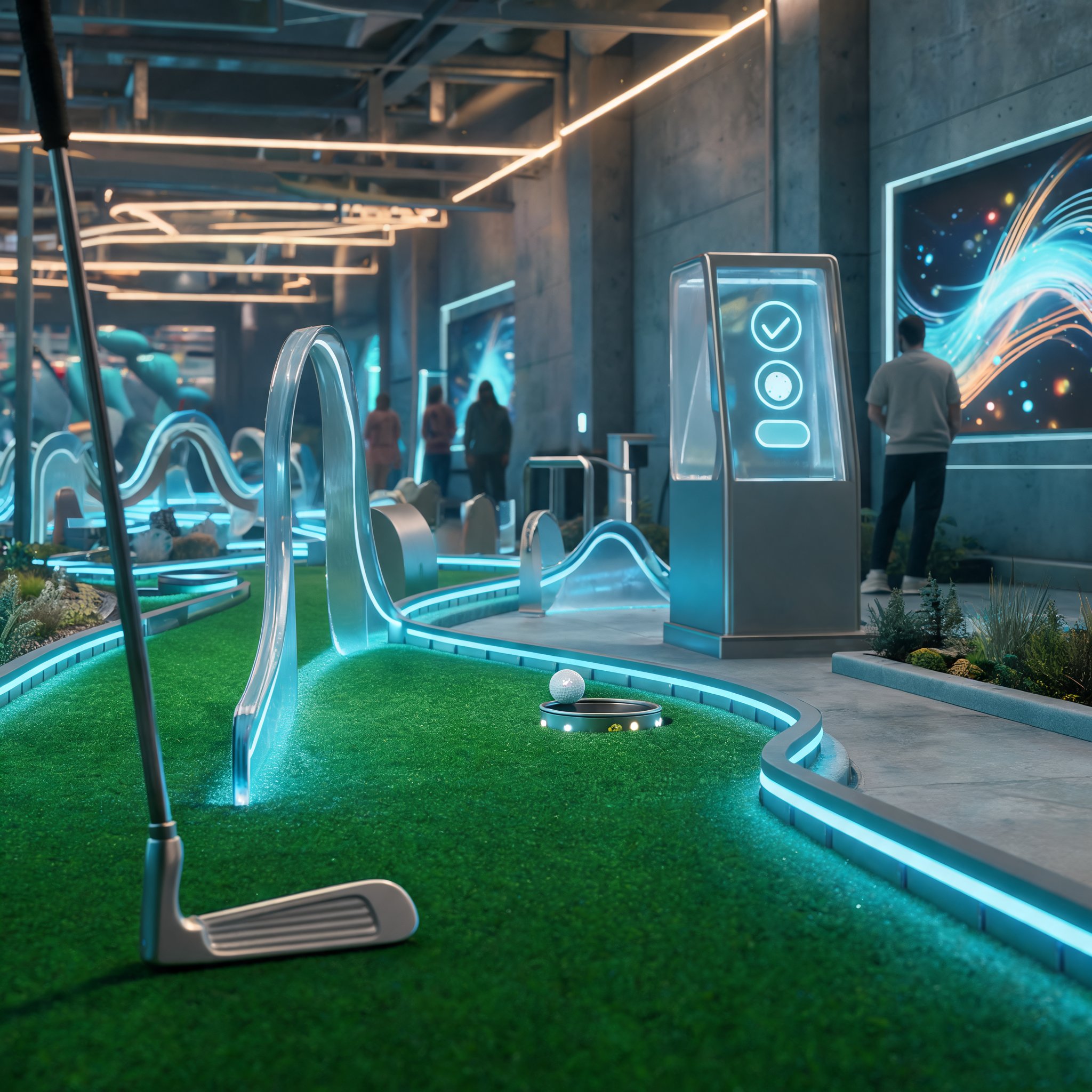
Holovis is repositioning miniature golf for the competitive socialising market. Rather than sell only themed holes, its 360Golf brand combines a traditional putting experience with automated scoring, game mechanics, player accounts and operator analytics. The offer is aimed at venues that compete for repeat visits and secondary spending.
The strategic bet is familiarity. Stuart Edgington, global director of business development, says mini golf already has global recognition and does not need to be reinvented. 360Golf instead layers technology onto that base. Visitors can register, receive a smart ball and begin playing without a long explanation or heavy staff involvement. That low-friction start matters because the format is intended to appeal to families, young adult groups and corporate outings at the same time.
From scorekeeping to a game layer
The technical foundation is automated scoring. Smart balls, tees and cups work with HoloTrac to remove paper scorecards and to act as a referee. On top of that, 360Golf adds SuperShots for alternative scoring routes, Triumphs that present awards and unlock challenges, bonuses, on-course games, player accounts, achievements, leaderboards and video celebrations. These features are designed to create reasons to compete, celebrate and compare results, and then to return for another round.
That game layer is also a data layer. The DeepSmarts AI engine gives operators and Holovis information on player interaction, seasonality, uptime and course performance. Holovis says the insights can be used to shape promotions, target quieter periods or underserved groups, and adjust operations. The same system can support remote troubleshooting: if a venue reports an unusual fault, the team can review what happened and identify the issue without automatically sending an engineer.
Operations and revenue
360Golf is designed around throughput. Holovis says a course can handle up to 80 people per hour, and that the kiosk-led flow lets guests understand the game, collect their ball and play with minimal staff assistance. Staff can then concentrate on hospitality, food and drink. Matt Dobbs, business development director, links that division of labour to higher secondary spend, although the revenue effect is presented as the company's commercial case rather than an independently verified outcome.
The operating model is supported by maintenance choices. 360Golf is described as robust and repairable to extend equipment life and reduce waste. DeepSmarts adds a diagnostic layer for remote support. For multi-site operators, the common technology also provides a baseline for consistency. Saudi Entertainment Ventures (SEVEN) is cited as an operator that can maintain standards across locations while varying theming, layout or branding; the technology allows the sites to be networked together.
Flexible formats, different venues
The product is not limited to one construction model. Operators can choose a technology-only retrofit for an existing mini golf course, select tried-and-tested catalogue holes, or commission a fully bespoke installation. Holovis says tech-only deployments take about six to eight weeks, catalogue holes eight to 12 weeks, and custom courses six months or more.
That range explains why 360Golf appears in very different settings. At Butlin's Bognor Regis resort, the £15m PLAYXPERIENCE indoor activity centre opened in 2024 with three nine-hole courses: a neon glow course, a Las Vegas-themed course and a wheelchair-accessible music-themed course. Dobbs says the tech-putt attraction has reached 5,000 players in a busy week and grossed around £40,000 in weekly revenue. In Leopardstown, Ireland, Super Social includes 12 holes from a sports-themed package. Norwegian Cruise Line has four Tee Time installations using marine-grade, waterproof equipment, rugged cups and tees and specialist screens. Netflix House's Top 9 course is fully custom and IP-led, with holes themed around One Piece, Squid Game and Floor is Lava.
Inclusive design is part of the customisation. Holovis says it considers right- and left-handed play, putter sizes for taller guests, wheelchair access to the course through a drop-down top cap, tees placed near the edge where reaching over is necessary, and spacing between holes to reduce congestion and safety risks. These details are not peripheral: they determine whether a course can serve mixed-age groups and meet the operational realities of a public venue.
Scaling and the limits of the model
The platform approach gives Holovis several routes to growth. It can sell to large entertainment developments that need repeat visitation, smaller venues that want a lower-cost course without losing scoring and replayability, and operators that intend to build chains. It can also adapt to physical constraints. The Lucky Duck project in Norway is a custom course with two routes on each hole, showing how the same technology can support new play patterns and make better use of space.
The wider ambition extends beyond golf. Holovis is working with Roxy Leisure to add stroke-counting technology to crazy pool tables, and Maaz Ussen, project manager, says the company wants to apply its technology to other sports. That is an expansion plan, not an established business line. The more immediate constraint is market maturity. Edgington expects competitive socialising eventually to reach peak saturation, which is why 360Golf is being positioned as a platform that can be adapted rather than a single-format attraction.
The commercial claims still need to be read with that in mind. Holovis reports strong global demand and cites installations across the UK, Europe, the Middle East, North America and Asia Pacific. It also presents high throughput and strong return on investment as potential outcomes for operators. The evidence in the article is largely company-provided, but the operating logic is clear: automated scoring reduces friction, gamification encourages repeat play, and data helps venues tune capacity, promotions and food and beverage sales. Whether those advantages hold across different sites will depend on local pricing, guest mix and execution.
360Golf is scheduled to appear at the Land Leisure & Tourism Show at NEC Birmingham on 4–5 November and at IAAPA Expo in Orlando on 16–20 November. Holovis will use the events to present the platform as a turnkey offer, from course design and technology through to commercial modelling. The message is that operators are not simply buying holes and putters; they are buying a connected attraction designed to generate measurable play, spending and return visits.